

On a chilly morning on the river, there’s a bunch of rowers and coxes who suffer more than most – those who, like me, have Raynaud’s phenomenon. This is a bizarre circulatory disorder, affecting about 10 million people in the UK. It interrupts the blood supply to the extremities in a dramatic way that doesn’t happen to most people. During an attack of Raynaud’s your fingers and toes go bright white and numb. They may then go blue before, in a rush of pain, the blood returns. It can happen even when you step from a warm room to a colder one. Gripping a cold oar handle certainly triggers it, as does sitting in the cox’s seat for an hour or so on a cold day. Rowing with Raynaud’s – to say nothing of coxing – is no joke. And for someone who likes to look at least tolerably soignée when I’m rowing, it’s a bit of a nightmare.
Which is why I take my kit so seriously. Get it right and you can still come off the water with a smile on your face. Get it wrong and you’ll be weeping and wincing your way up and down the river. Over the last few years I’ve dedicated an abnormal amount of time and trouble to thinking about my rowing apparel and I think I’ve finally got it nailed. So here is Girl on the River’s guide to rowing and coxing with Raynaud’s.
Rowing
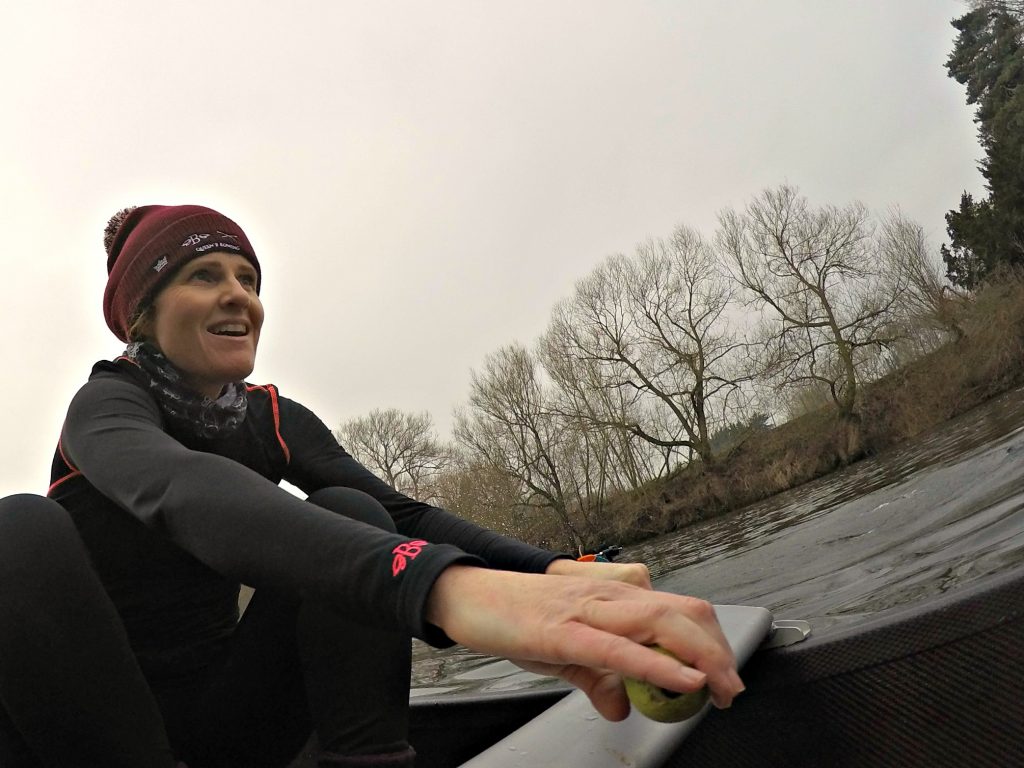
I’d like to say it was rocket science, but really it’s not. The key to staying warm is layers – and lots of them. This Sunday, when I took these pictures, it a damp, bone-chilling 1ºC, yet I managed to stay warm enough not to think about my hands and feet at all when I was on the water.
My kit list was as follows:
- Base layer (Queen B Athletics)
- Thermal polo neck (Lidl)
- Fleece (Craghoppers)
- Warm leggings (I’d have gone for a second pair if we’d hit freezing point)
- Leg warmers (so I’m a child of the eighties – don’t judge me. And these are actually key. If you keep your legs and ankles warm your feet have a much better chance of not seizing up).
- Thermal socks
- Thin buff
- Thick buff
- Hat (Queen B Athletics)
- Coat (removed when I got into the boat)

I also wore thick waterproof gloves from Sealskinz to carry the boat on and off the water.

Once on the water I attached pogies (from Rock the Boat) to my handles. These are covers that protect your hands whilst allowing you to maintain contact with the handle. They’re not everybody’s cup of tea but I’m a fan – they keep the wind off and allow your hands to adjust to the cold of the handle a little less brutally. You can swipe them off when you warm up. The only problem is that they are fiddly to wriggle your hand into. If you start the outing by sitting the boat and then have to join in suddenly you may end up, as I did, with one pogie on and one pogie off.

As the outing progressed, I shed more and more layers including, finally, my hat, pulling the buff up to create a faintly ridiculous and piratical bit of headwear. It kept the wind off my ears (which can also go numb) and my hair out of my eyes.

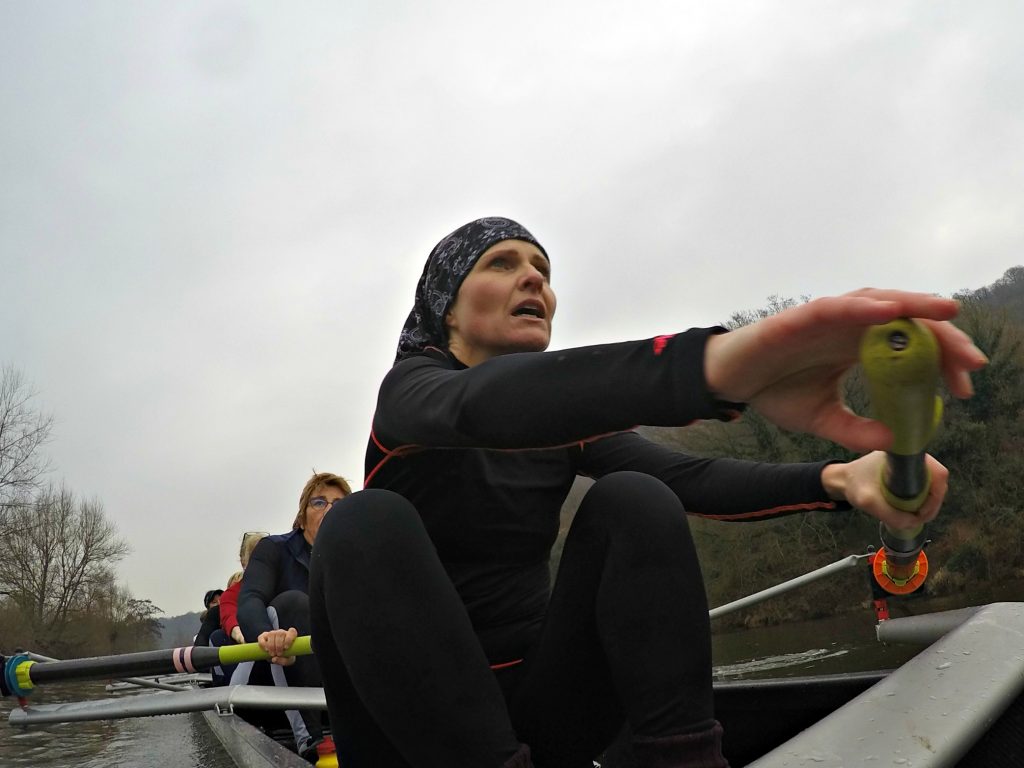
The only time I really got cold was afterwards in our unheated clubhouse, when even a cup of coffee didn’t stop me shivering.
Coxing
As I stepped out of the house to cox this Saturday it was a biting minus 4°C. Happily I’d thought ahead and, amazingly, didn’t feel cold at all during the outing.

This was my kit list:
- Base layer (Queen B Athletics)
- Thermal polo neck (Lidl)
- Soft shell top (MRC)
- Padded jacket (Reebok)
- Warm leggings (Queen B Athletics)
- Ski trousers (so old I don’t even know what make they are)
- Thin buff
- Thick buff (Kit Crew)
- Socks
- Trainers
- Neoprene overshoes
- Thermal waterproof gloves (Sealskinz)
- Cap (Crewroom)
- Hat (Queen B Athletics)
The key to my joyous warmth was two-fold. In addition to all the layers I had handwarmers tucked into my gloves and footwarmers inside my trainers, providing a constant source of heat.

But my secret weapon was a pair of cyclist’s neoprene overshoes. These, brilliantly, kept the wind and splashes out and the heat in but were perfectly safe to wear in the boat as they have holes on the sole and the heels. I heartily recommend them.
I’m constantly tweaking and refining my rowing kit so if you have any brainy ideas or top tips for keeping warm on the water, I’m all ears (under my hat, that is). ‘Till then, stay warm and row like the wind.






I find a few other items helpful to stay warm in sub zero conditions:
I take off my big winter jacket (too bulky to row in) and fold it over the shoes in the boat. My feet are never cold and I can put it on as soon as we get back to the dock. A towel folded over the shoes will also work.
My top layer when rowing is always a water repellant turtle sleeveless top to keep me relatively dry in case the rower in front of me splashes excessively at the catch. It is vital to stay dry on the outside when it is below freezing.
On our river in Connecticut (USA) the winter temps are often well below freezing but we have a dedicated and hearty group rowing quads 4 or 5 times a week. It can be alarming to row through skim ice -it makes a horrific sound against the hull of the boat!
Oh wow, advice from someone who REALLY knows what they’re talking about. I haven’t had the experience of rowing through ice – just of ice forming on the riggers and hull. Great advice – and yes, no fun when you’re near someone splashy on a cold day! Thanks so much for sharing your thoughts.
Excellent advice. I suffer from Reynaud’s also. For those of us who launch from the beach, rather than a dock, it is hard to keep our feet truly warm in the winter. We walk the boat into the water, so need to be in bare feet or booties. I wear neoprene surf boots, the sort surfers wear with their wet suits. That makes walking on the cold sand tolerable. I keep a set of lined boots (Ugg knock offs) in the trunk of the car to change into after we finish.
Great ideas! You could even put foot warmers into your Uggs in advance so they’re even toastier when you put them back on again!
Why don’t you try the Sealskinz waterproof long socks? They’re amazing!
I do have some of them and use them in wet weather, but don’t find they keep the cold out. The neoprene booties keep the wind out and the warmth in really effectively.
Coxes might also find a flotation suit (made by a company called Fladen) really helpful. I use one in winter for coaching and umpiring from a launch, and I know of at least one school which issues them to coxes.
I’ve not heard of these – will have to go and look them up. I’m picturing something huge and inflated, Michelin Man-stylee!
There is an alternative, cheap option. I put Vaseline (petroleum jelly) on my toes before I put my socks on. The vas acts as a barrier to the cold, and as a poor conductor of heat it tends to keep the warmth in. Can’t use it on my hands, but do rub it on my wrists, to help blood flow from the relative warmth of my arms through to my fingers.
I’ve never heard this tip before, but willing to give most things a try. Not sure how I like the idea of slippery, sticky, Vaseliney toes, though…
I really suffer and appreciate your tips. Thank you.
Glad it’s helpful!